The 2026 Hospital Price Report
We analyzed 169,852 published prices from 1,030 hospitals across the country — every price taken from the machine-readable files hospitals are required by federal law to publish. Here's what the numbers say.
Data as of October 16, 2026 — this report is a snapshot of that date. For current figures, see live coverage.
1. The same surgery can cost 20x more depending on the hospital
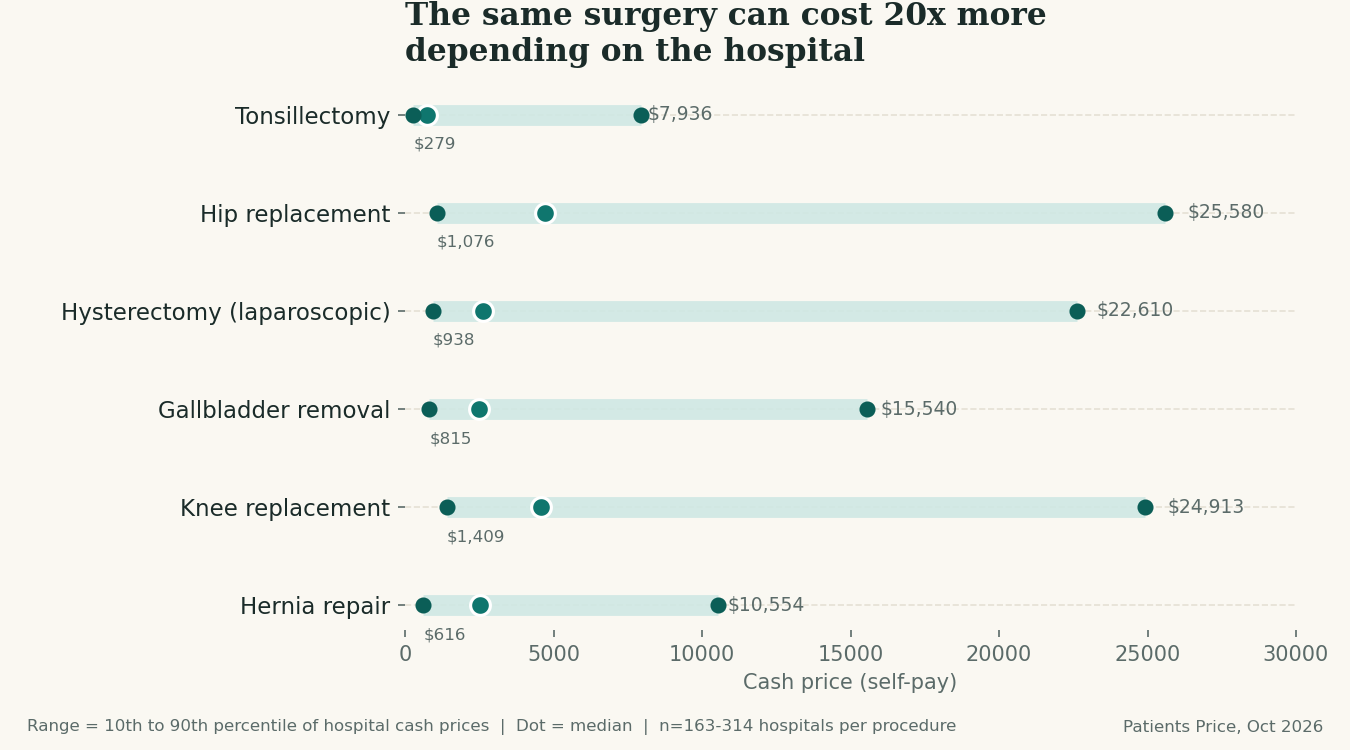
A hip replacement costs a typical (median) hospital $4,722 in cash. At the 90th percentile hospital, it's $25,580 — and at the 10th, just $1,076. That's a 24-fold spread for the same operation. Tonsillectomy is worse: $279 to $7,936, a 28-fold gap.
Why? Because these prices were never set by anything resembling a market. Hospital "chargemasters" were invented decades ago as opening bids for negotiations with insurers, then inflated year after year with no connection to cost. Where a hospital has market power — the only game in town — there's little pressure to keep the numbers sane.
Our finding matches published research: KFF Health News found a brain MRI with contrast listed from $1,720 to $8,800 across hospitals, and a BMJ Open study of California hospitals found one hospital charging $10 for a cholesterol test while another charged $10,169 — over 1,000x more — which researchers called "irrational."
2. Paying cash beats using insurance 30% of the time
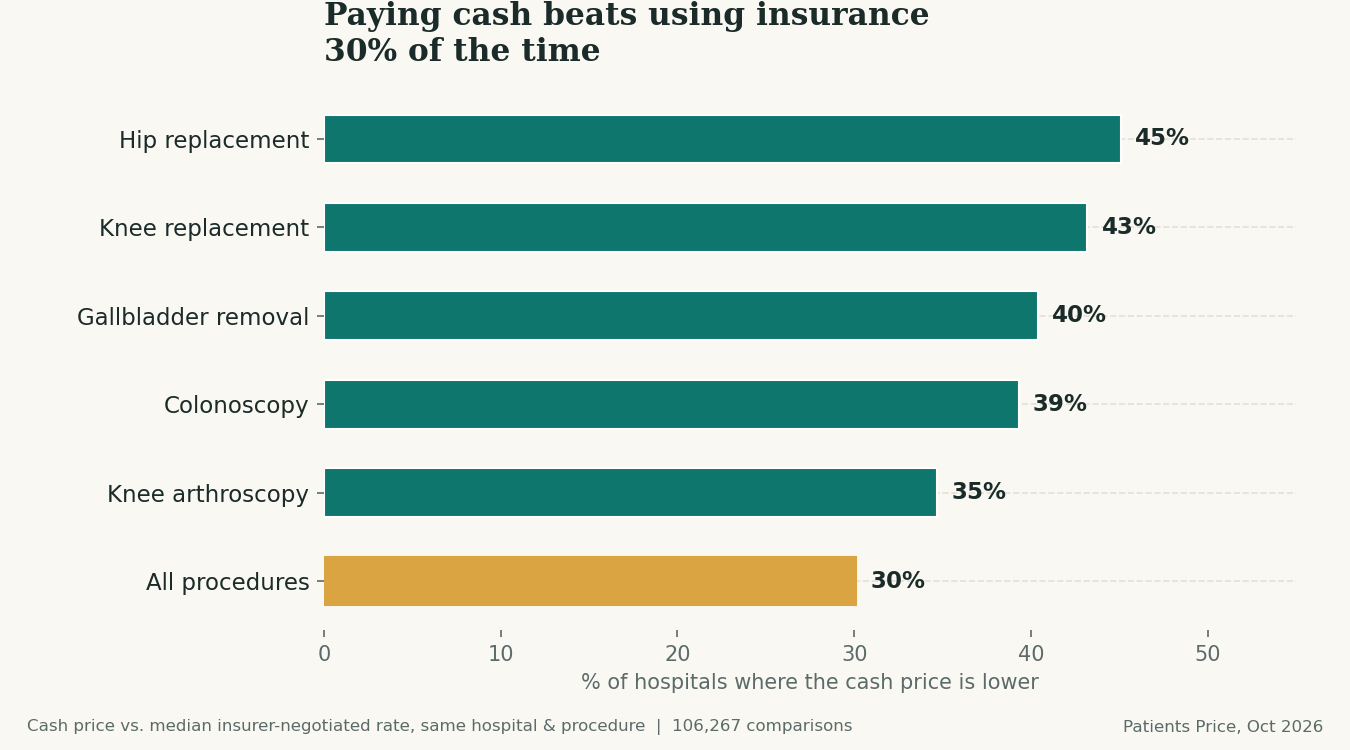
Across 106,267 head-to-head comparisons at the same hospital for the same procedure, the self-pay cash price was lower than the median insurer-negotiated rate 30% of the time. For hip replacements it's 45%; for knee replacements 43%; for gallbladder removal 40%.
Why? Cash is cheap to collect: no claims, no denials, no billing department chasing payment for months. Hospitals pass some of that saving on. And if you're on a high-deductible plan and haven't met your deductible, you're paying the "negotiated" rate out of pocket — which may be the worse deal.
A Health Affairs study of 107,737 hospital-procedure combinations found cash prices below the median negotiated rate roughly half the time — our 30% is the conservative end. And a 2026 study in the American Journal of Managed Care found the same pattern for physician-administered drugs.
3. The sticker price is theater
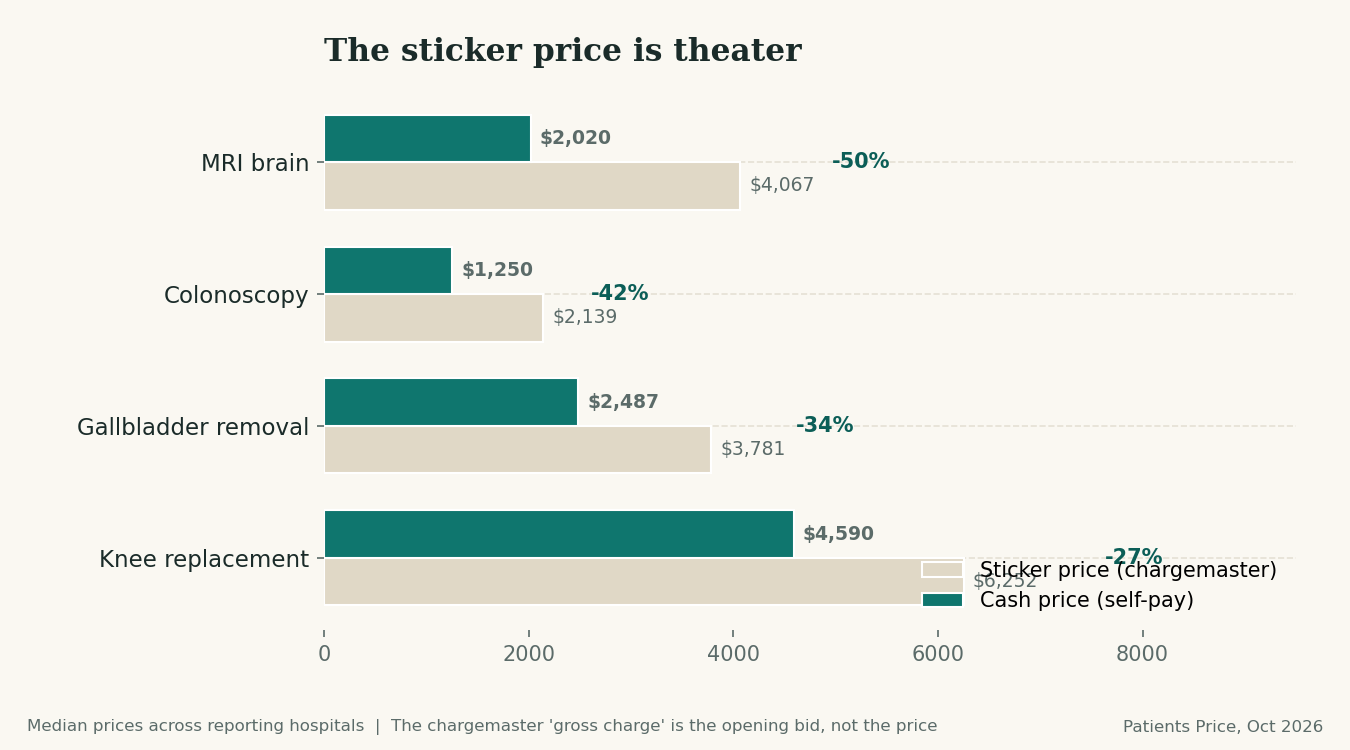
The "gross charge" — the chargemaster sticker price — is roughly double what a cash patient actually pays. An MRI billed at $4,067 on the chargemaster goes for $2,020 in cash. Nobody pays the sticker price; it exists so insurers can brag about the discount they "negotiated."
Why it matters: uninsured patients are the ones most likely to be shown the sticker price first. If you don't know to ask for the cash price, you can be billed double for the crime of not knowing.
The Health Affairs research above mapped the same three-way relationship — chargemaster, cash, negotiated — and found the chargemaster consistently the highest and least meaningful number.
4. Where you live matters as much as what you need
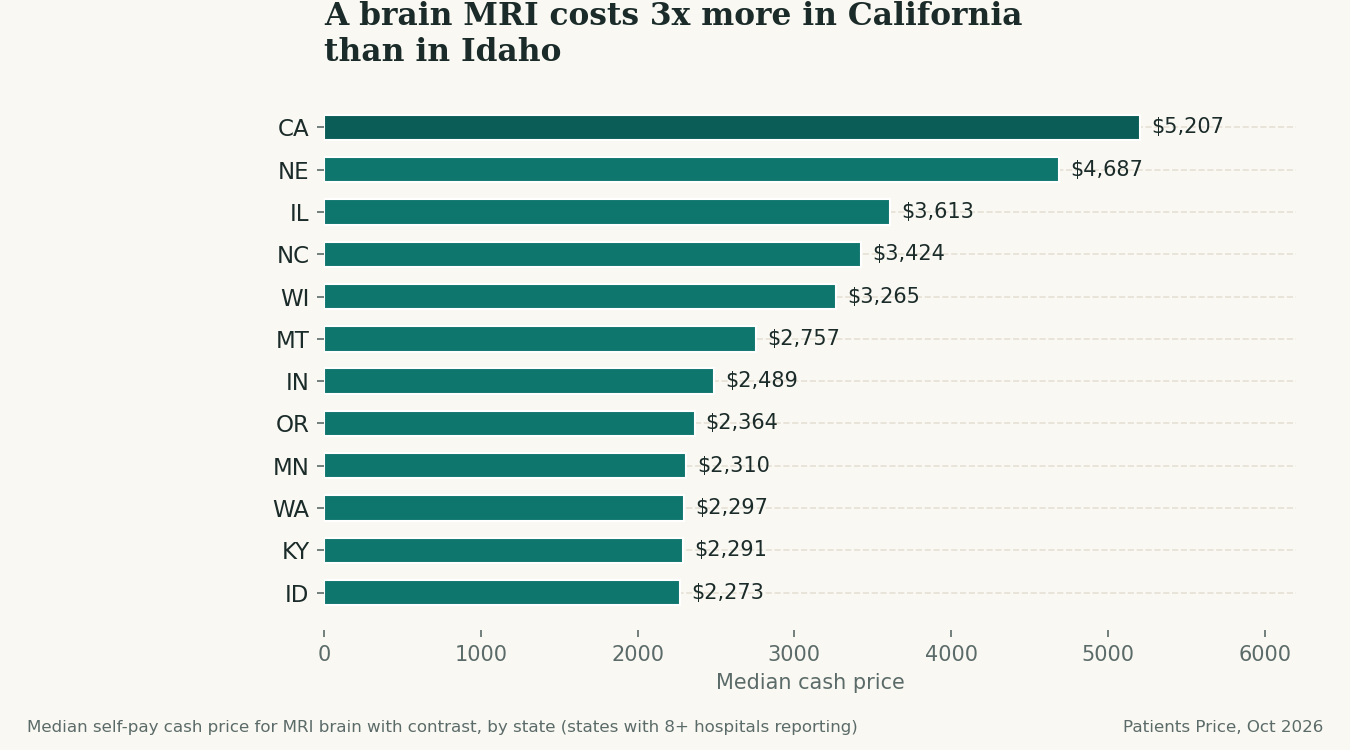
A brain MRI with contrast costs a median of $5,207 in California and $2,273 in Idaho — same scan, 2.3x the price, and that's comparing medians. The extremes are wider still.
Why? Local market consolidation is the biggest driver researchers point to: where a few systems own most hospitals, prices rise. Cost of living and state regulation play supporting roles. If your procedure is shoppable and you're near a state line, the drive can pay for itself many times over.
KFF Health News has documented the same geography lottery repeatedly — Medicare's own data showed neighboring hospitals charging wildly different amounts for identical care.
5. Surgery prices are a lottery; childbirth is merely unfair
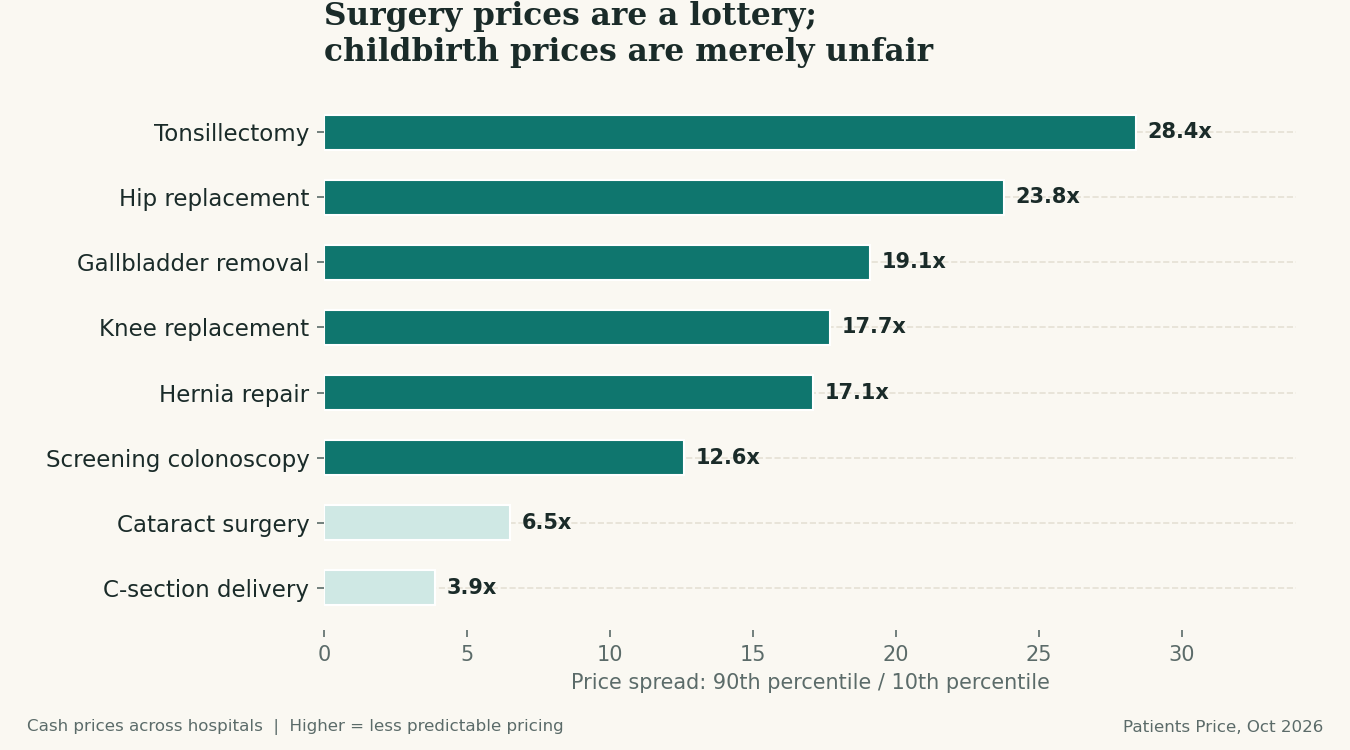
Some procedures have predictable prices and some don't. Surgery is the wild west — tonsillectomy varies 28-fold hospital to hospital. Childbirth is expensive everywhere but comparatively consistent: C-sections range about 4x. The pattern: the more "shoppable" a procedure (planned in advance), the more hospitals compete on cash price — and the wider the spread between the competitors and everyone else.
Explore the full ranking yourself:
Ranked by price spread (90th percentile / 10th percentile). Click a column to sort.
| Procedure | Hospitals | 10th %ile | Median | 90th %ile | Spread |
|---|
Covers the 51 procedures with plain-English names and 30+ reporting hospitals. Percentiles of hospital cash (self-pay) prices.
6. Compare your state
Pick a procedure to see how its median cash price varies by state:
States with 5+ hospitals reporting a cash price for the procedure.
7. An honest caveat: some published prices are fiction
One large California health system lists total knee replacement cash prices between $49 and $464 across a dozen hospitals — numbers that can't reflect the true cost of the surgery. It's a reporting error on their end, and it's in the file they published to comply with federal law.
That tells you something about this whole transparency project: hospitals self-report these files and nobody validates them. The Government Accountability Office has reported that regulators don't know whether the published prices are correct or complete, and researchers keep finding "zombie rates" — prices for services hospitals don't even provide.
KFF Health News documented "zombie" rates and inconsistencies in published price files, including insurers reporting payments to dentists for knee replacements. Treat every number — including ours — as the hospital's claim, not gospel.
Methodology & limitations
Data: 169,852 prices from machine-readable files published by 1,030 U.S. hospitals under the federal hospital price-transparency rule, collected October 2026. Cash price = the hospital's discounted self-pay price. Negotiated rates = payer-specific contracted rates; we compare cash against each hospital's median negotiated rate.
What we don't claim: 1,030 hospitals is about a fifth of U.S. hospitals — big academic centers are overrepresented among recent additions and rural hospitals underrepresented. We cover 226 common procedures, not everything a hospital does. Percentiles describe the hospitals that published usable prices, which may differ from those that didn't. We never estimate or alter a hospital's numbers.
Read the full methodology. Questions or corrections: contact us.